

SARAJEVO (BOSNIA ERZEGOVINA) (ITALPRESS/FENA) – More than 100,000 tourists visited Sarajevo in July alone, while a series of major events is turning the city into one of the liveliest destinations in the Balkans this summer. Forty years after the Winter Olympics, Sarajevo is once again demonstrating how powerfully it can attract people from around the world – this time through music, film, art and the vibrancy of city life.
One of the summer’s most remarkable moments came in late July and early August, when more than 200,000 people filled Koševo Stadium over three consecutive nights for concerts by regional music star Dino Merlin. The scale of the event was unprecedented, but even more significant was what it created: the music of one man brought together people from different parts of Europe and once again turned the Olympic stadium into a place of togetherness.
People from across the region and from throughout Europe travelled to Sarajevo for his concerts. Among them were visitors who did not speak Bosnian but had learned to sing along with Merlin’s songs. Some visited the city for the first time specifically because of him. Chiara Fortunato from Barcelona travelled to Sarajevo for the concert, while Zuzana Bajer learned Bosnian because of Merlin’s music and later moved to Sarajevo. Stories like these show that the phenomenon cannot be reduced to visitor numbers alone. People from around the world came because they had fallen in love with music they had not grown up with and did not necessarily understand the language of.
But the most powerful image was also the simplest: more than 200,000 people singing together over three days. And what happened at Koševo quickly spilled over into the rest of the city. During the three days of Merlin’s concerts, Sarajevo recorded nearly €78 million in fiscal turnover, as hotels and private accommodation struggled to meet the surge in demand. The surge in visitors was felt far beyond the stadium – in restaurants, cafés, shops, transportation and other businesses. Major events are thus increasingly becoming a driving force behind Sarajevo’s tourism: they attract new visitors, extend their stays and give them a reason to explore Sarajevo beyond the event itself.
After Merlin’s concerts, Sarajevo carried on almost without a pause, with a packed calendar of major events. A concert by legendary band The Prodigy on August 13 brought another major wave of visitors, and the very next day the city shifted from a concert to a cinematic rhythm with the opening of the 32nd Sarajevo Film Festival.
Launched in 1995, during the final year of the siege of Sarajevo, the SFF has grown into one of Europe’s most important film events. This year’s guests include Woody Harrelson, Emily Watson, Paweł Pawlikowski, Diego Luna, Asghar Farhadi and Céline Sciamma. The Sarajevo Film Festival is one of the best examples of the city’s transformation. An event that emerged at a time when Sarajevo was a symbol of war has today become one of its most recognizable international cultural brands.
During the festival, the city is almost constantly alive with screenings, concerts, parties and encounters with guests from around the world. This summer, music and film are telling the same story – that of a city that brings people together.
Yet what keeps tourists in Sarajevo extends far beyond its major events. Within just a few minutes’ walk, visitors can travel through several centuries of European history. Baščaršija preserves Ottoman architecture, old artisan streets, mosques, inns and the tradition of Bosnian coffee, while just a few hundred metres away, the streets and architecture reflect the Austro-Hungarian period.
In the city centre, within a few hundred metres of one another, stand mosques, churches and a synagogue, which is why Sarajevo has often been described throughout history as a meeting place of cultures and religions. Its history also includes events that changed the world, including the assassination of Austro-Hungarian heir to the throne Franz Ferdinand, an event that directly triggered the outbreak of World War I. There are also numerous sites preserving the memory of the siege of Sarajevo from 1992 to 1995.
For some foreign visitors, Sarajevo is still primarily associated with the war because of television images from the 1990s. Today’s city, however, presents a very different picture. Its central streets are filled with tourists, restaurants, cafés, festivals and cultural events.
At the same time, Sarajevo offers something many European capitals do not – Olympic mountains that can be reached in just 15 minutes or so. Trebević rises directly above the city, while Bjelašnica, Igman and Jahorina are all within easy reach, offering visitors the chance to combine a city break with hiking, cycling or winter sports.
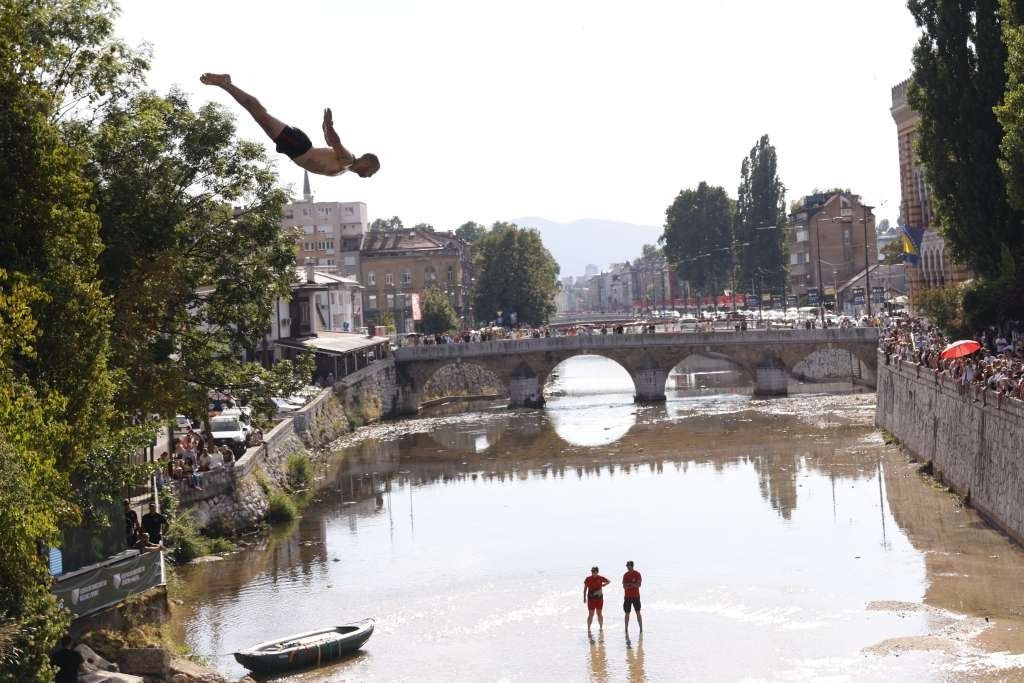
Another unusual Sarajevo tradition is associated with Bentbaša, just a few minutes from Baščaršija, where cliff diving takes place on the Miljacka River. Few European capitals host such a sporting event in the heart of the city, surrounded by cliffs and a historic urban setting. All of this is contributing to Sarajevo’s growing popularity as a tourist destination.
But perhaps Sarajevo this summer is best understood through what has unfolded between Koševo and the city’s festival streets.
Forty years ago, people came to Sarajevo to be part of the Olympics. After the war, in 1997, U2 sent a powerful message with its concert at Koševo that Sarajevo had returned to the world. Today, four decades after the Olympics, people are once again coming to Sarajevo – but this time to celebrate. They come for music, film, art, gastronomy and the energy of city life. They come for major names in global culture, but also for artists from this city whose songs travel far beyond its borders.
-Photo Fena-
(ITALPRESS).