


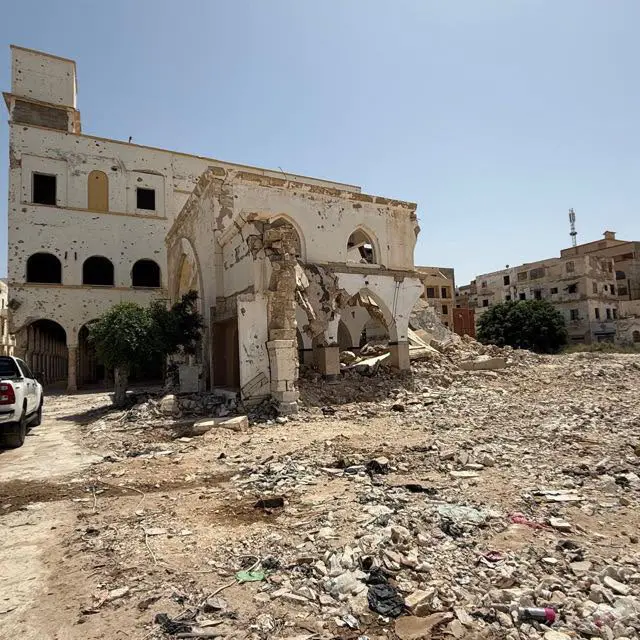
ROME (ITALPRESS/MNA) – The Italian-Libyan Chamber of Commerce is set to travel to Benghazi again tomorrow, Monday 28 September. President Nicola Colicchi and director Francesco Muraca will accompany a delegation of companies and professionals specialising in restoration, engineering and construction, who will carry out site inspections together with engineers from the Libya Development and Reconstruction Fund.
The mission includes Pasqualucci, Piacenti, Europa Engineering, Renco and engineer Paolo Capaldini, who has previously worked on restoration projects in areas of Abruzzo affected by the earthquake.
The visit comes just weeks after Benghazi Urban, the international exhibition devoted to the reconstruction of the city and promoted by the Fund’s director, engineer Belqasim Haftar. At the event, held in Benghazi from 6 to 8 September, the Chamber brought together more than 40 leading Italian companies, professionals and organisations, making it the largest foreign delegation in attendance. Participation was coordinated by Colicchi and director Francesco Muraca.
Particular attention focused on the historic centre, designed and built by Italians in the last century and later destroyed during recent conflicts. Ahead of the exhibition, Colicchi himself recalled that the historic centre has Italian origins, with Italian styles, names and architecture, and that it is important for Italy to contribute to the city’s revival.
The site inspections form part of discussions already under way with the Fund over the restoration of the historic heart of Benghazi. On 13 September, the Libyan news agency reported on a meeting in Benghazi between Mohamed al Hassadi, chairman of the committee for the reconstruction of the Al-Sabri area and central Benghazi, and a Chamber team accompanied by representatives of specialist Italian companies.
On that occasion, the Chamber’s design team presented the master plan for the historic centre, with the aim of reconciling the preservation of its architectural identity with the need for modernisation. The committee was established under Resolution No. 10 of 2026 issued by the Fund.
A significant part of Benghazi’s Italian architectural heritage is concentrated in the heart of the city, an area scarred by the fighting of 2014-2017 and by subsequent demolitions. More than 150 buildings of architectural value have been catalogued there, including the Cathedral, whose construction began in 1929, former bank buildings and the Italian Consulate. The Berenice Theatre, designed by Marcello Piacentini and Luigi Piccinato, was demolished in 2023.
Pasqualucci is a Rome-based construction and restoration company active since 1945, with extensive experience in the restoration of historic monuments. Piacenti, based in Prato and with origins dating back to 1875, specialises in the conservation of protected buildings and seismic upgrading. Renco, a Pesaro-based group active in engineering, construction and services, already has a permanent presence in Libya, with its own office in Tripoli and operational activities in the country. Studio Capaldini was also among the Italian organisations represented at Benghazi Urban.
The Chamber, a non-profit association founded in Rome in 1997, has its headquarters in the Italian capital, an office in Tripoli and a representative office in Benghazi, announced during the Italian-Libyan Economic Forum in June 2025, organised jointly with the Fund. That mission had already involved Italian companies active in engineering, infrastructure, renewable energy and cultural heritage.
Photo: Italian-Libyan Chamber of Commerce-
(ITALPRESS).