

VALLETTA (MALTA) (ITALPRESS/MNA) – Malta has been shrouded in Saharan dust in recent days, driving air pollution to levels far exceeding international health guidelines.
Airborne particle concentrations have surpassed six times the World Health Organisation’s recommended daily limit, according to data from the country’s monitoring network.
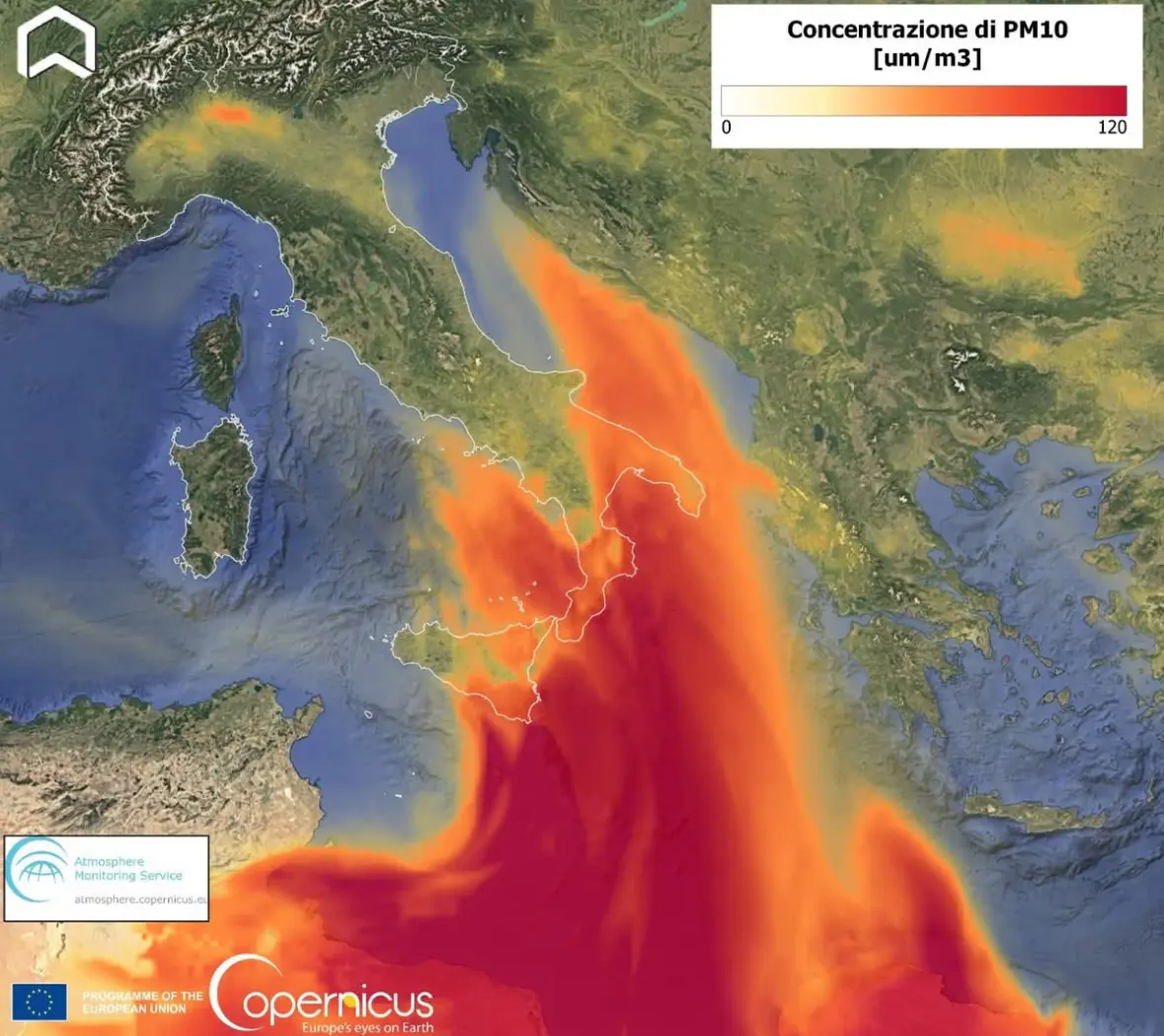
Satellite imagery from the EU’s Copernicus programme shows a vast plume of dust stretching from North Africa across the Mediterranean and beyond Sicily.
Malta’s five air quality stations — Attard, Għarb, Msida, Żejtun and St Paul’s Bay — registered sharp spikes in pollution on Wednesday and Thursday morning, with levels continuing to climb.
All stations recorded PM10 concentrations more than four times the WHO’s 24-hour mean limit of 45µg/m³. Most peaked near 250µg/m³, while Msida approached 300µg/m³.
Meteorological officials said the dust originated in the Sahara and was carried over the central Mediterranean by strong southwesterly winds. Conditions are expected to improve in the coming hours.
PM10 particles, small enough to enter the respiratory system, are linked to worsened asthma, respiratory infections and other health risks. Typical sources include construction, traffic emissions, landfills and wildfires.
Environmental experts noted that although the dust degrades air quality, it also plays a natural ecological role.
Marine biologist Alan Deidun said Saharan dust, rich in iron and trace elements, acts as a fertiliser for marine ecosystems, supporting plankton growth weeks after major events.
He added that the dust can also benefit terrestrial plants in Malta’s typically alkaline soils and has even been traced as far as the Amazon rainforest.
Saharan dust episodes are a recurring feature in Malta, often creating hazy skies and coating surfaces in fine sand.
– Photo EU Copernicus programme –
(ITALPRESS).