

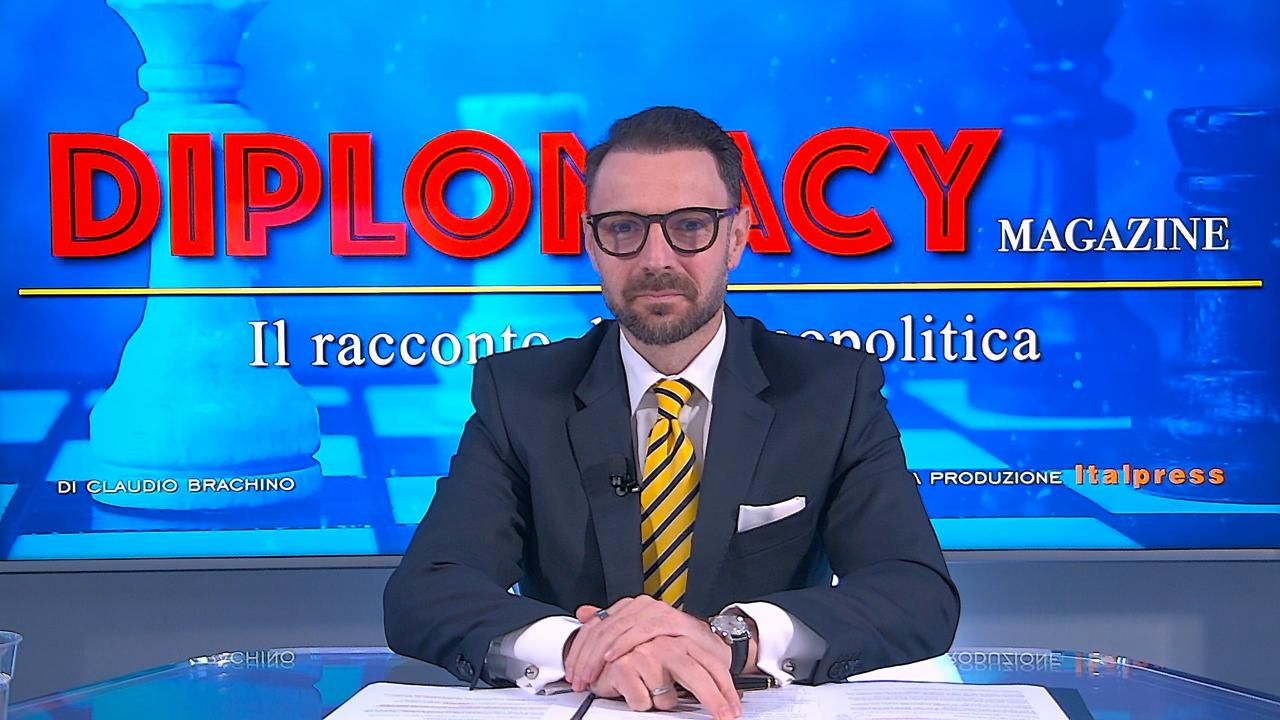
ROME (ITALPRESS/MNA) – Relations between Italy and Hungary rest on “solid foundations,” cemented by a strategic partnership and regular political visits—most notably the trip to Rome last May by the new Hungarian Prime Minister, Péter Magyar. This is the view of Hungary’s Ambassador to Italy, Andor Ferenc Dávid, in an interview with Claudio Brachino for Diplomacy Magazine, the geopolitical column of the Italpress news agency.
The bilateral relationship between Italy and Hungary is so well-established that it prompted Mr. Magyar to visit Italy immediately after his election, even before he had officially taken office, the Ambassador noted. “Before he had even taken office, he was received by Prime Minister Giorgia Meloni on May 7th. There have been other meetings as well—for instance, between our respective Foreign Ministers during the ‘Friends of the Western Balkans’ gathering, and between the speakers of our parliamentary assemblies, Mr. Fontana and Mr. Forsthofer, also here in Rome,” Dávid observed. Regarding the strategic partnership, signed in 2010, the diplomat added: “I believe this framework has provided opportunities for development in the economic, cultural, and social spheres.”
According to Dávid, “Italy is a major nation—a founding member of the European Union and a member of the G7 and G20. Italy’s voice is undoubtedly significant, not only in European politics but on the global stage as well.” For this reason, coordination with Italy can be highly beneficial within “various international forums” and on issues of shared interest—ranging from energy and immigration to the topic of European enlargement in the Western Balkans. From an economic perspective, the goal “is to keep improving,” the diplomat notes. “I would like to see much broader exchange and cooperation among small and medium-sized enterprises (SMEs), which are the backbone of our economies,” he observes. “Large corporations are fairly autonomous in seeking out their own markets and partnerships, but SMEs are the ones that need a kind of ‘push’—the sort of support we, as an embassy, can provide—to help them find new partnerships and opportunities.”
According to David, organizing B2B events or exhibitions can help foster reflection on joint projects. “Hungary can offer significant added value, as our country places a strong focus on research and innovation,” he points out, noting how academic research in Hungary intersects with sectors such as IT, energy, and logistics. “There are various areas where we can engage in more concrete cooperation with our Italian partners,” he concludes. The ambassador also cites an ongoing investment with Italian partners at the port of Trieste—an initiative he hopes will continue to progress—which will provide a new gateway to Central Europe and its markets, as well as to the Western Balkans.
As for the Hungarian market itself, David notes that it is already on Italy’s radar. “Two major Italian banks are present in Hungary, and they have already made a significant contribution to the economy—benefiting both Hungarian businesses and households. They possess know-how that can be valuable not only to Hungarian entrepreneurs looking to expand into Italy, but also to Italian entrepreneurs looking to enter the Hungarian market,” the diplomat adds.
From an investment perspective, according to David, “one must always consider the most important factor: that the market and the country in which one invests are reliable, and that the rules are clear.” In Hungary, this is coupled with the attractiveness of certain sectors—such as energy, mechanical engineering, and logistics, as well as pharmaceuticals, a field in which the country boasts a long-standing tradition. “Therefore, what I would like to say to Italian investors is that they are welcome in Hungary, where they can find advanced enterprises and a wide range of potential partners suited to their specific needs.”
According to David, Hungary also proves to be a reliable partner in a broader sense—not just economically, but also within the European Union, of which it is a member. “The Hungarian government is prepared to work closely with its European partners for the sake of common security and well-being. Hungary is a reliable partner—one that is open to dialogue and that respects and upholds the treaties it has signed. It is a partner that understands its place within the Euro-Atlantic system—a framework that offers ample opportunity to represent one’s own national interests, yet without seeking a monopoly, but rather with a sensitivity toward others. For it is only by understanding the intentions and the concerns of other nations that one can reach an agreement and a common policy,” he observes, going on to cite issues such as common defense and the protection of external borders. “Hungary will always remain a very reliable partner, now and in the future,” he reaffirms.
Ultimately, the closeness between the two countries is fostered, above all, through mutual understanding between their respective peoples. “Italian and Hungarian cultures share deep roots. Looking back at our thousand-year history, when Hungary adopted Christianity as its official religion, our first king received his crown from Italy—from Rome,” the ambassador recalls. “During the Renaissance, various Italian scholars and scientists were present at the courts of Hungarian kings, and during the Italian Risorgimento, Hungarians fought alongside Garibaldi’s forces. Furthermore, we cannot forget the generous support shown by the Italian people during our 1956 Revolution, which was crushed by Soviet troops. In the aftermath, Italy demonstrated exceptional solidarity by welcoming many refugees from Hungary. Many of them stayed and began new lives here,” notes the head of the diplomatic mission in Rome. In light of these long-standing ties, Hungary has maintained a Cultural Institute in Rome “for a hundred years now; I invite all viewers to come and see this magnificent building—a true jewel of Roman architecture.” “I believe this dimension is one of the most beautiful aspects of our bilateral relations—a dimension that will continue to flourish and bear fruit well into the future,” concludes Ambassador Andor Ferenc Dávid.
– Photo Italpress –
(ITALPRESS).