

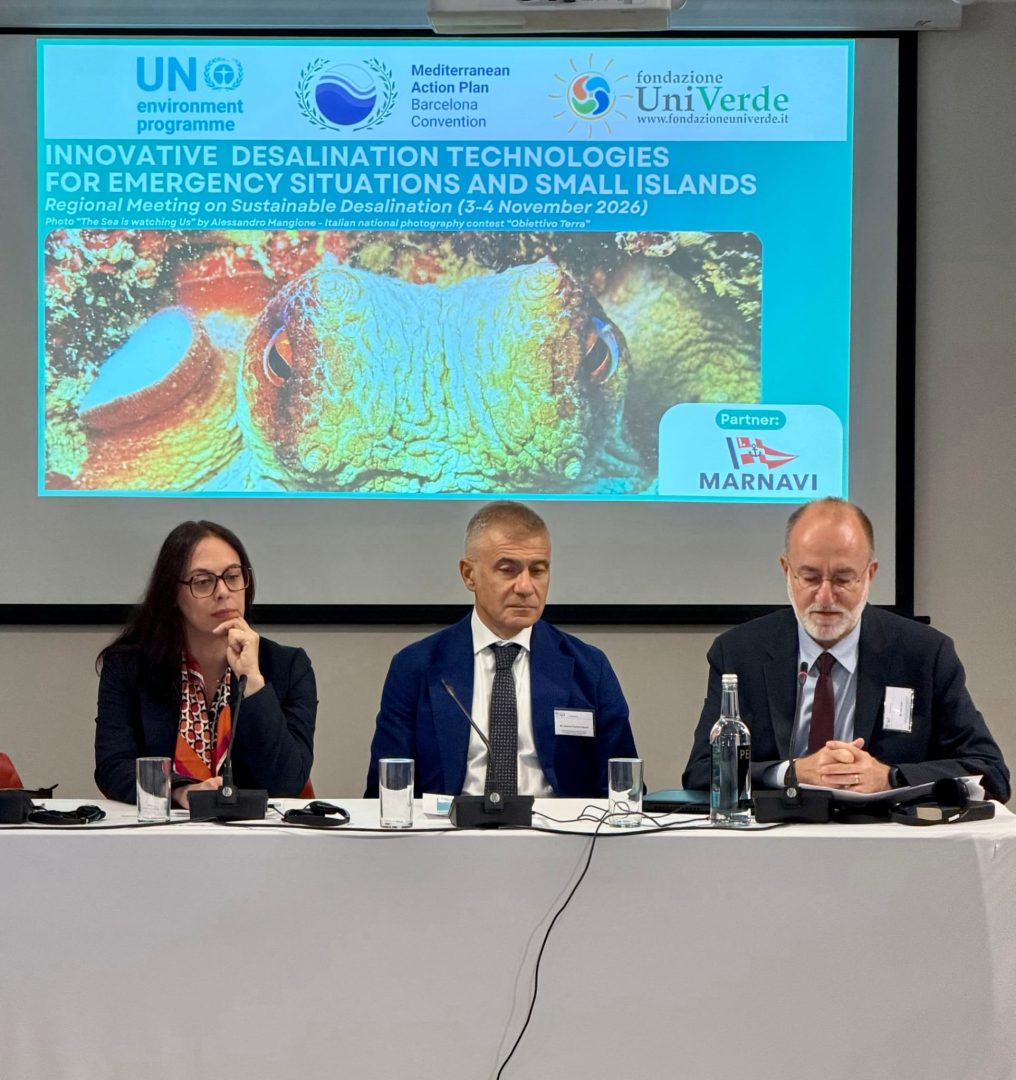
ROME (ITALPRESS/MNA) – The UniVerde Foundation continues its commitment to contributing to the achievement of Goal 6 of the 2030 Agenda, which focuses on the availability and sustainable management of water and sanitation for all. Following the multimedia photographic exhibition “Water, Biodiversity, and Landscape: A Journey Through Italy’s Protected Areas” — promoted in collaboration with the UNESCO World Water Assessment Programme (WWAP) and supported by the One Water Italia Committee, and inaugurated in Rome by the Minister of Environment and Energy Security, Gilberto Pichetto Fratin, during the Euro-Mediterranean One Water Forum—the Foundation’s efforts have moved to Malta. There, as part of the “Regional Meeting on Sustainable Desalination” (held on November 3–4 and organized by the United Nations Environment Programme’s Mediterranean Action Plan, UNEP/MAP), the UniVerde Foundation hosted a session titled “Innovative Desalination Technologies for Emergency Situations and Smaller Islands”, which featured the participation of Valentina Setta, Ambassador of Italy to Malta.
Having been elected as a member of the Mediterranean Commission on Sustainable Development under UNEP/MAP, the UniVerde Foundation aims to reinvigorate dialogue among Mediterranean basin countries regarding the needs of island communities and populations vulnerable to water crises. The focus is on archipelagos and smaller islands—territories characterized by particularly fragile ecosystems—where the necessity of ensuring a water supply for the population (including during the peak of summer tourism) must be balanced with the protection of the marine environment, biodiversity, and the landscape. The discussion examined solutions suitable for communities with small resident populations that experience sharp seasonal spikes in water demand. It evaluated the role of innovative technologies and mobile seawater desalination systems, considering factors such as costs, environmental impacts, and the ability to respond promptly to water needs.
The proceedings opened with remarks from Atila Uras, Senior Technical Officer at UNEP/MAP, who stated: “Water scarcity is becoming one of the most critical challenges for the Mediterranean. Desalination is evolving from a supplementary or emergency water supply option into a structural component of water security and climate change adaptation strategies. However, the expansion of freshwater production must not come at the expense of the marine environment. Our goal is to ensure that desalination contributes to water security while remaining ecologically sustainable and consistent with the commitments set out in the Barcelona Convention. The challenge is not merely to produce more freshwater, but to ensure reliable and efficient water supplies while protecting the marine ecosystems upon which our communities depend.” Alfonso Pecoraro Scanio (President of the UniVerde Foundation, former Minister of Agriculture and the Environment): “The challenge of sustainable desalination holds a dual value: on one hand, the protection of the Mediterranean Sea—a basin extraordinarily rich in biodiversity yet extremely delicate, and a true hotspot for climate change; on the other, the guarantee of every citizen’s fundamental right to quality drinking water.
This commitment aligns with the United Nations 2030 Agenda—specifically Goal 6, which focuses on access to and the sustainable management of water and sanitation, and Goal 14, which aims for the conservation and responsible use of oceans, seas, and marine resources. In this context, the UniVerde Foundation is dedicated to supporting research and innovation—including by promoting ‘Made in Italy’ solutions—that can render new desalination technologies more environmentally, economically, and socially sustainable. A virtuous example is the mobile marine desalination unit installed on a dedicated vessel; this solution is highly regarded by the scientific community for its ability to disperse brine in deep waters—ensuring high dilution and minimal impact, thanks to the movement of the ship’s propellers while underway. Safeguarding smaller islands and archipelagos remains the core objective of this sustainable approach, as it avoids the need for fixed plants, which lead to land consumption, landscape alteration, and energy waste—and, particularly in protected areas, pose a serious threat to habitats and biodiversity”.
This was followed by an institutional address from: Valentina Setta (Ambassador of Italy to Malta): “Water security represents one of the crucial challenges for the future of the Mediterranean. For island nations like Malta, sustainable desalination is not merely a technological option, but an essential component of resilience and sustainable development”.
– photo UniVerde Foundation –
(ITALPRESS).