

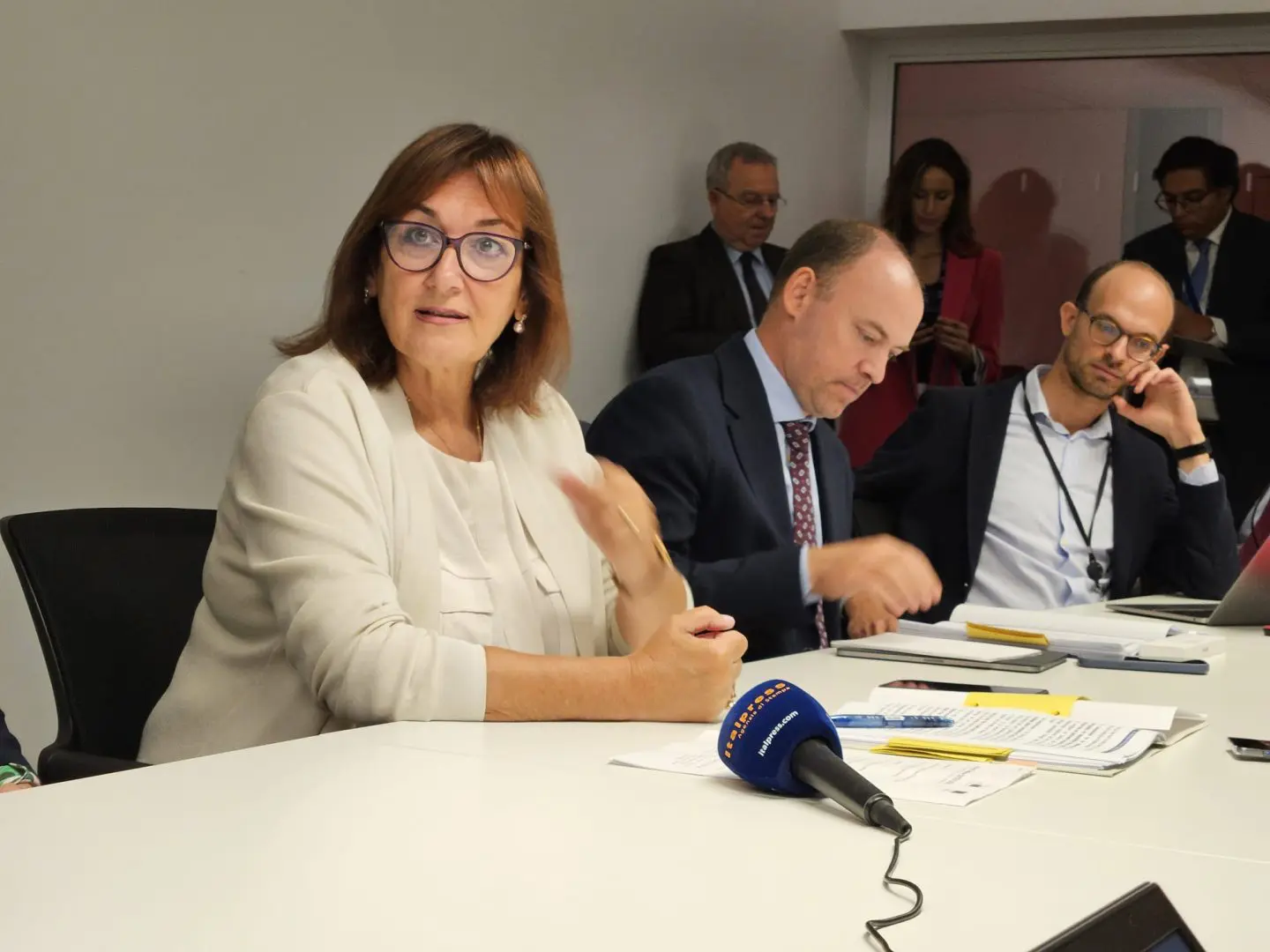
STRASBOURG (FRANCE) (ITALPRESS/MNA) – “The Pact for the Mediterranean forms the framework for our work.” This was stated by Dubravka Šuica, the European Commissioner for the Mediterranean, while meeting with the Italian media on the sidelines of the European Parliament plenary session in Strasbourg.
The initiative, launched in November 2025, is an action plan based on three pillars: people as a driving force for change, connections, and innovation; stronger, more sustainable, and integrated economies; and security, preparedness, and migration management. Regarding the first pillar, Šuica cited—among other things—the Mediterranean University project, a network linking universities in Europe and North Africa designed to “connect young people across the Mediterranean—researchers, students, and anyone interested in participating. Naturally, the decision to join rests with the individual universities, but I believe they will be willing to do so. We have already initiated discussions with some of them and believe this is the right path forward”.
“In his report, Enrico Letta advocates for the ‘right to stay.’ This can only be realized by creating the conditions that allow people to actually remain where they are. I speak in these terms because my portfolio also covers demography,” the EU Commissioner said.
“For me, it is crucial to create conditions that allow young people to stay in Italy, but we must also help people remain in Syria. When we need experts, we establish talent partnerships. Some politicians misuse this issue by deliberately conflating legal and illegal migration. Illegal immigration is out of the question; we oppose it and are fighting against it. We are doing everything possible to counter it.”
“We enter into talent partnership agreements with the governments of various countries and welcome some of their experts, while taking care to avoid causing a ‘brain drain.’ We act collaboratively. It is essential that citizens are aware of this, given that we have a genuine need for labor.”
“Essentially, it is a matter of finding a complex and balanced solution to various needs,” she added. “We are seeking to support the development of these countries through local investments, encouraging European companies to invest in that region—particularly in renewable energy,” Suica continued.
“Our goal is to generate renewable energy locally, thereby lowering production costs and helping us break free from fossil fuels—specifically those from Putin. Naturally, this is no simple undertaking, as it requires establishing interconnections between Spain and Morocco, Tunisia and Italy, and Egypt and Greece. If we succeed in building these links, energy will effectively become cheaper. Beyond fostering development in these countries, this energy production creates new job opportunities for local youth”.
“We are concluding partnership agreements with all the countries involved. Currently, we have comprehensive partnership agreements with Tunisia, Egypt, and Jordan. We were on the verge of signing one with Morocco as well, but the process is on hold due to the events of July 31 [the Ceuta crisis—Ed.]. We have also initiated negotiations for similar agreements with Bahrain and the UAE, and are nearing a conclusion with Saudi Arabia and Qatar. These partnership agreements cover not only migration but also the economy, energy, education, people-to-people exchanges, and any other aspect subject to negotiation in our bilateral agreements. We aim to create mutually beneficial solutions; that is the approach we are taking”.
ON CEUTA: “NO EVIDENCE THE CRISIS WAS PROVOKED BY MOROCCAN AUTHORITIES”
There is no evidence that the migrant crisis in Ceuta was in any way instigated by Moroccan authorities. This point was emphasized by the European Commissioner for the Mediterranean. “I have been in constant contact with Moroccan Foreign Minister Nasser Bourita since day one. There is no evidence that they are exploiting the situation or using it as a weapon. No evidence,” Suica explained. “The question of this alleged instrumentalization ought to be verified, but it is not up to the Commission to conduct such investigations. At the same time, their willingness to take all these people back within a day or two demonstrates that they were not the ones who orchestrated the situation”.
Negotiations for a comprehensive strategic partnership agreement between the EU and Morocco “are currently on hold because we want to see a genuine commitment and a willingness on their part to help us resolve the problem,” the European Commissioner emphasized.
“Naturally, there are still minors—between one and two thousand—there; Morocco is willing to take them in, but the issue is that Spanish authorities require written guarantees from Moroccan authorities regarding the acceptance of these individuals. We must adhere to international law: Spanish authorities are bound by it and cannot repatriate minors without guarantees—for instance, in the absence of contact with their families or similar situations. Coordination efforts are therefore underway between the Spanish Foreign Minister and the Moroccan authorities. We are trying to provide assistance to manage the situation.”
“This concerns our external border—Europe’s external border—and we must address it. I am not assigning blame, nor am I suggesting that Spanish authorities have not done enough, but we must continue to protect Europe’s external border,” Suica concluded. “The current problem involves minors, but I hope the issue will be resolved soon. Morocco is an important country for Europe; there are mutual interests at stake, and they need us. I hope the matter does not become overly politicized, but the lesson we draw from this is that we must secure our borders”.
– Photo sat/Italpress –
(ITALPRESS).